
If you’re still running the same strategies you used last year, you’ll notice the difference by mid-2026. The digital marketing world doesn’t wait; it moves fast, and the rules are changing.
This guide breaks down 10 trends that matter for Greenville businesses right now: AI doing the heavy lifting, video dominating budgets, email delivering insane ROI, and platforms becoming full-blown commerce channels. But more importantly, it tells you exactly what to do about each one, without the corporate jargon or overwhelming checklists.
TL;DR? Pick 2-3 trends that fit your business. Execute them consistently. That’s how you actually stay ahead.

Look, I’ll be straight with you.
If you’re running the same marketing strategy you used in 2025, you’re probably going to struggle. Not tomorrow. But by mid-2026? Yeah, you’re going to notice.
I was talking to a local business owner in Greenville last week—he runs an e-commerce store—and he told me he’s been doing the exact same Facebook ads for eighteen months. Said his ROI dropped 40% in the last quarter alone. I asked him what he was doing about it. His answer? Nothing. He was waiting to see what happens.
That’s the problem, right there.
The digital world doesn’t wait. It moves. Fast.
So I figured I’d put together what I’m actually seeing happen in marketing right now. Not some predictable “10 trends” list where everything sounds the same. Just… what’s real. What’s changing? What you should probably know about.
Why Does Any Of This Matter For Greenville?
Greenville’s not some small town anymore.
The economy here is legitimately booming. Since 2001, we’ve added 37,400 jobs. BMW’s here. Michelin. Prisma Health. These are serious companies with serious budgets.
But here’s what that also means: competition is fierce. There are way more businesses fighting for customer attention than there were five years ago.
The old advantage—just having a decent product—that’s not enough anymore. Everyone has a decent product. What separates winners from losers now? It’s visibility. It’s being found by the right people at the right time. It’s building actual trust.
And most businesses in Greenville aren’t doing that. They’re just… existing online. Hoping.
1: AI Is Doing The Heavy Lifting In Personalization
Here’s the thing about AI that nobody talks about:
It’s not going to write your emails for you (though some companies try, and it shows). What it’s actually good at is noticing patterns nobody else can see.
Like—I work with a Shopify store. Their bounce rate was around 45%. Pretty standard for e-commerce. But the owner never looked deeper. She just assumed that’s how e-commerce worked.
Then she set up AI-powered product recommendations. Same traffic. Different results.
Bounce rate dropped to 28%. Conversion rate went up 3.2%.
She didn’t do anything different. The AI just showed different products to different people based on their behavior. One person sees “bestsellers.” Another sees “items on sale.” A third sees “products people like you bought.”
That’s what AI is doing in 2026. It’s not magic. It’s just pattern-matching at scale.
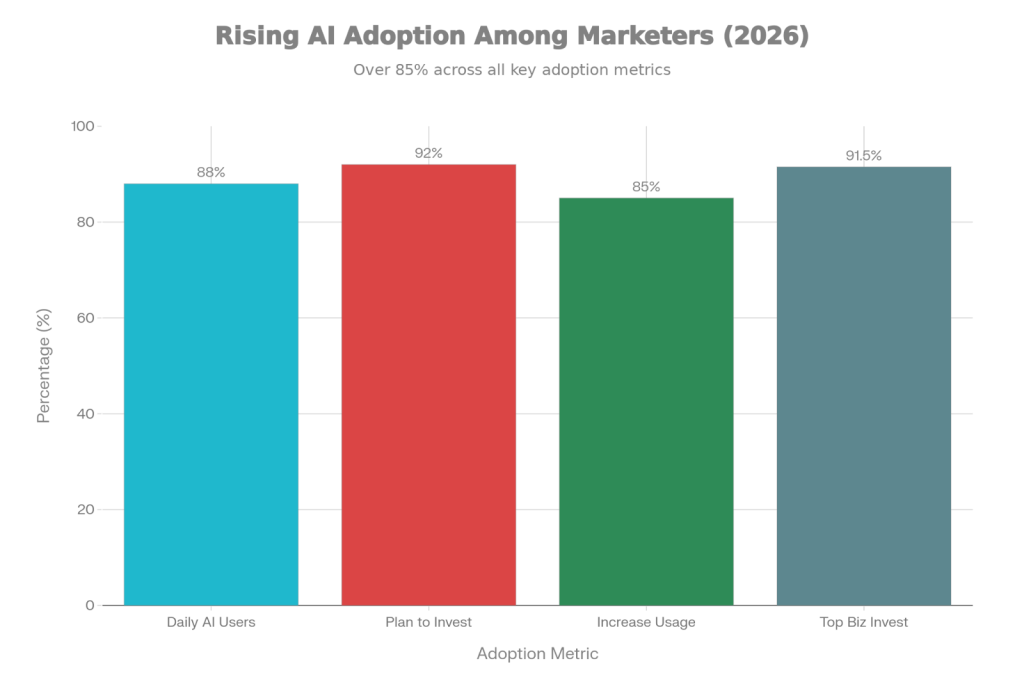
Right now, 88% of digital marketers are using AI daily. That’s not some future trend. That’s today. That’s normal now.
The market agrees. The AI marketing industry went from $47.32 billion in 2025 to a projected $107.5 billion by 2028.
For your business:
If you’re on Shopify or WooCommerce, stop ignoring those AI recommendation features. They’re built in. They work. Turn them on.
If you’re running email campaigns, there are AI tools that optimize send times for each individual person. Not one person spends time with everyone. Different times for different people based on when they actually open emails.
These aren’t fancy. They’re just… efficient.

2: Video Is Where The Money Is Going (And It’s Not Slowing Down)
I’ve watched businesses struggle with video for years.
They think they need a production crew. They think they need a script. They think they need to look “professional.”
Meanwhile, the most engaging content online is usually shot on an iPhone in someone’s office.
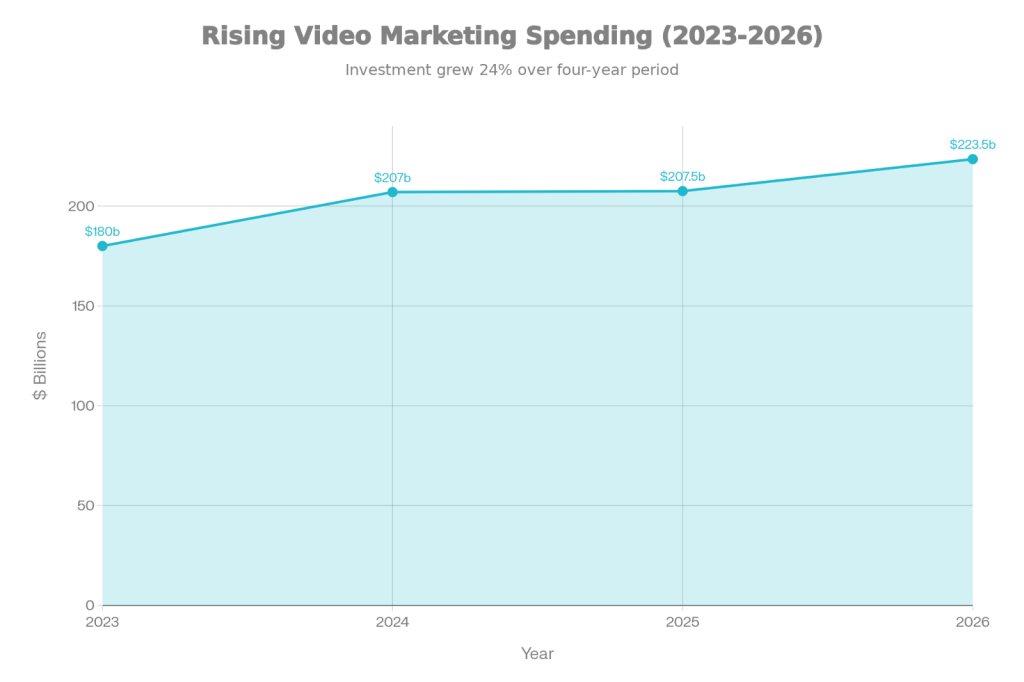
Here’s what I see happening: Global video ad spending is sitting at about $207 billion in 2024 and heading toward $223.5 billion by 2026.
That’s real money. And short-form video is eating everyone’s lunch. Short-form video ads are hitting $122.5 billion in 2026.
TikTok. Instagram Reels. YouTube Shorts. That’s where people are. That’s where attention is. That’s where budgets are moving.
Here’s what actually converts: 87% of people say they’ve bought something after watching a demo video. Not “thought about buying.” Actually bought.
For Greenville businesses:
Stop thinking you need to be perfect.
Shoot a 45-second video on your phone showing your product. Or showing a customer using it. Or showing you fixing something or creating something. Post it to Instagram Reels or TikTok.
Do this weekly. Don’t overthink it.
One restaurant owner I know started posting 30-second videos of how they make their signature dish. Nothing fancy. Just filming with his phone camera while he’s actually making it. His Instagram engagement went from maybe 20-30 likes per post to 400-600 likes per post in six weeks.
His foot traffic up? Slightly. But more importantly, his online presence is no longer invisible.
That matters.
3: Google Search Just Isn’t The Only Game Anymore
This one’s weird because it’s happening right now and most people haven’t noticed.
Google has AI. ChatGPT is a search engine now (people literally type questions into it instead of Google). TikTok is becoming a search engine. Perplexity is answering questions with summarized information from multiple sources.
The way people find things is fractured. It’s not Google anymore.
This changes how you should write content. Instead of optimizing for keywords (which is what SEO meant for like 15 years), you’re now optimizing for AI understanding.
It’s being called Generative Engine Optimization, which is a fancy term for “write content that makes sense to both humans and AI systems.”
What that actually means:
Write long, thorough pieces about topics you know well. Answer the actual questions people ask. Do your research. Cite sources. Write like you know what you’re talking about—because you should.
When someone asks ChatGPT, “What’s the best CRM for small businesses in Greenville?”, is your blog post the most comprehensive, most recent, most helpful answer out there? ChatGPT might literally recommend your post to them.
For your business:
Stop writing 400-word blog posts for search rankings. Write 2,000-3,000-word guides that actually answer questions completely. Make them good. Make them real.
4: Email Marketing Has The Best ROI Of Anything You Could Possibly Do
I’m about to tell you something that’ll sound insane.
For every dollar you spend on email marketing, you make back $36-$38 in revenue.
That’s 3,600-3,800% ROI.
Let me compare that to other channels:
- Google Ads: 800% ROI
- SEO: 825% ROI
- Social Media Ads: Usually 200-400% ROI
Email isn’t just better. Email is in a completely different universe.
And 392 billion emails are being sent every single day. This isn’t a dying channel. This is a tsunami.
Here’s where it gets interesting: automation is changing everything.
You know when someone puts something in their shopping cart and then leaves without buying? That abandoned cart? You send them an email reminder. Just reminding them. That email generates $3.07 per person in revenue.
You’re not being clever. You’re not writing some amazing copy. You’re just reminding people they wanted something.
For your business:
If you have an online store and you’re not sending abandoned cart emails, you’re literally throwing money away. This isn’t complicated. Shopify, WooCommerce—they all have this built in. Turn it on.
If you don’t have an email list, build one. Add a simple form to your website. Offer something people actually want in exchange for their email (discount code, free guide, checklist, whatever makes sense for your business).
Then email them. Regularly. Like, actually useful stuff. Not spam. Real updates about your business.
The ROI will shock you.

5: Amazon And Walmart Are Becoming Ad Networks
For decades, if you wanted to advertise online, you had basically two choices: Google or Facebook.
That’s not true anymore.
Amazon has an advertising business now. So does Walmart. So does Target. Retail Media Networks—these ads on major retailer websites—are growing 14.1% year-over-year.
In a few years, RMNs are on track to become the second-largest digital ad channel in the world, overtaking paid search.
Why? Because Amazon and Walmart know what people want to buy in real time. They own the customer, the product, AND the checkout. It’s a closed loop.
For your business:
If you’re selling products on Amazon, Walmart, or similar platforms, you need to be advertising there. Your competitors definitely are.
If you’re selling locally, ignore this for now. But watch it. The space is expanding.

6: Big Celebrity Influencers Don’t Actually Work Anymore
This took me a while to understand, but it makes sense when you think about it.
A celebrity with two million followers, where 1% actually care, isn’t worth as much as a micro-creator with 10,000 followers, where 80% actually engage.
Brands are starting to figure this out. Companies are now spending 20-30% of their marketing budgets on influencer partnerships, and that money is moving toward smaller creators with engaged audiences.
Here’s what’s interesting: 61% of marketers plan to increase their influencer spending in 2026. The budget is moving this way. But only 27% of influencer content actually feels like it fits the brand naturally.
That means there’s a huge gap. A huge opportunity.
For Greenville businesses:
Find local creators who genuinely like your stuff. Not mega-influencers. Regular people on Instagram or TikTok with maybe 5,000-20,000 followers. People whose followers actually look like your customers.
Reach out. Offer a product. Ask them to share their honest opinion. Pay them fairly.
A micro-influencer from Greenville with an engaged audience beats a random celebrity every time.
7: Your Social Media Is Now A Store
Instagram just added shopping directly in the app. You can tap a product and buy it without ever leaving Instagram. Same with TikTok. Facebook, too.
The social media ad market is growing 11.4% in 2026. And social media’s share of marketing budgets is projected to hit 18.4% within five years.
But it’s not just ads anymore. It’s literally shopping.
Gen Z is buying stuff via TikTok Shop. They’re watching livestreams and buying directly from creators. The friction between seeing something and buying something is basically gone now.
For your business:
If you sell physical products, tag your products in your Instagram posts. Make them shoppable. Every step you remove from the buying process = more sales.
If you’re a service business, use video to show your work. Go live on Instagram or TikTok and answer questions in real time. Build a community right there where people actually are.
8: Build Community, Not Audiences
Here’s something I’ve noticed: people don’t trust brands. They trust other people.
90% of Reddit users actually trust Reddit for product advice. They’re asking strangers for help instead of looking at ads.
In 2026, smart brands aren’t just broadcasting messages. They’re hanging out in communities where customers already are.
Reddit. Discord. LinkedIn groups. Facebook groups in specific niches. These are places where real conversations happen.
For your business:
Join the communities where your customers hang out. Answer questions. Be helpful. Share insights. Don’t always be promoting yourself.
Spend 30 minutes a day in these communities. Just help people. No agenda. No sales pitch.
That builds trust. Slow. But it builds.
9: Static Posts Are Dead (Engagement Is In Interactive Stuff)
Here’s what I’ve noticed: static posts get ignored. Interactive stuff doesn’t.
A poll gets more engagement than a carousel. A quiz gets more engagement than an article. A calculator gets more engagement than a comparison post.
44.4% of marketers who use interactive content report higher success rates.
For your business:
This week, create one interactive thing. A poll on your Instagram story asking what product you should launch next. A quiz about which service fits customers best. A calculator for estimating something relevant to your business.
Post it. See what happens. Compare it to your typical engagement.
You’ll see the difference immediately.
10: Privacy Is Actually A Selling Point Now
Weird one to end on, but it’s true.
People are tired of creepy tracking. Tired of ads following them around. Privacy laws are getting stricter every year.
Brands that are transparent about how they use customer data? People actually trust them more.
It’s not complicated. Just be honest.
For your business:
Make sure your privacy policy is written in actual English (not legal gibberish). Make it easy to find. Be clear about what data you collect and why.
If you’re doing email marketing, tell people exactly what they’re subscribing to. Make it easy to unsubscribe.
Transparency doesn’t hurt. It actually helps.
Real Talk: Don’t Do Everything
Most “trends to watch” posts will tell you to do all ten of these things. That’s stupid advice.
You can’t do all of this well. You’ll do all of it poorly instead.
Pick your lane based on your business:
E-commerce store?
- Video marketing (people buy more after watching demos)
- Email automation (the ROI is insane)
- Social shopping features (make products shoppable)
Service business?
- Email list building (stay in touch with past clients)
- Community engagement (be helpful when customers ask questions)
- Interactive content (quizzes, calculators, polls)
Local business?
- Social media for local customers (Instagram, Facebook, TikTok)
- Email list (keep customers coming back)
- Local micro-influencers (real people in Greenville)
Pick two or three. Do those really well.
What I’m Actually Seeing Work
I’m working with a Greenville manufacturing company right now. They sell B2B products. Not sexy stuff. Industrial equipment.
They started an email list six months ago. They email customers once a week with actual useful information (industry news, how-to guides, their own insights).
Their repeat customer rate went from 35% to 58% in six months.
One change. Email.
I’m also working with a local service business that started posting short videos on Instagram. 30 seconds. Showing how they solve problems. Nothing fancy.
Their inquiries went up 23% in three months.
One change. Video.
The thing is, these aren’t magic. It’s not some brilliant strategy. It’s just… actually showing up. Actually being helpful. Actually creating content that speaks to real people.
That works. More now than it ever has.
What To Do This Week (Pick One, Do It)
Stop reading. Start doing.
Option A: If you have an online store, set up abandoned cart emails. Takes a couple of hours. Could generate real money by next month.
Option B: Film one short video (30-60 seconds) showing something about your business. Post it to Instagram or TikTok. See what happens.
Option C: Find three communities where your customers hang out. Spend 20 minutes answering questions. No promotion. Just help.
Do one of these this week. Not all three. One.
Next week? Pick another one.
That’s how you actually stay ahead. You don’t do everything at once. You do something consistently, and you get better at it.
The Reality
2026 is going to be weird. AI will keep getting weirder. Platforms will keep adding features nobody asked for. Algorithms will change. Laws will tighten.
That’s all happening.
But here’s what actually matters: understanding your customers. Showing up consistently. Being authentic. Building trust.
Technology is just a tool. Your strategy is what actually moves the needle.
Pick the trends that fit your business. Execute them consistently. Stay human.
The winners in Greenville will be the ones who did that.
What’s your biggest marketing challenge right now? Genuinely curious. Drop a comment or message us. We actually read them.
P.S. Share this with other Greenville business owners if it was helpful. We all figure this stuff out better together than we do alone.
Source URLs:
https://entrepreneurshq.com/digital-marketing-industry-statistics/
https://upstatebusinessjournal.com/economic-development/greenvilles-economic-development-arm-aims-to-sustain-dramatic-growth/
https://greenvilleeconomicdevelopment.com/economy/