
Let me be honest about something most local shop owners won’t admit: They’re absolutely terrified of going online.
It’s not the complexity. Well, okay, it is partly that. But more than anything? They’re scared because their entire business model is built on face-to-face relationships. On customers walking through that door. On knowing them by name. On the personal touch that makes local retail special.
Then, a marketing consultant tells them they need to learn Shopify, set up an Instagram shop, and take professional product photos. It sounds impossible.
Here’s what nobody tells them, though: You don’t throw away your physical store. You add to it.
You’re not replacing the relationship business you’ve built. You’re expanding it to customers who would love to buy from you—but don’t know you exist yet. Or they’re too busy to visit. Or they live three towns over.
Best part? You can do this for less than a thousand bucks.

Local business owner with laptop showing online store, customers shopping, product display, mobile shopping experience
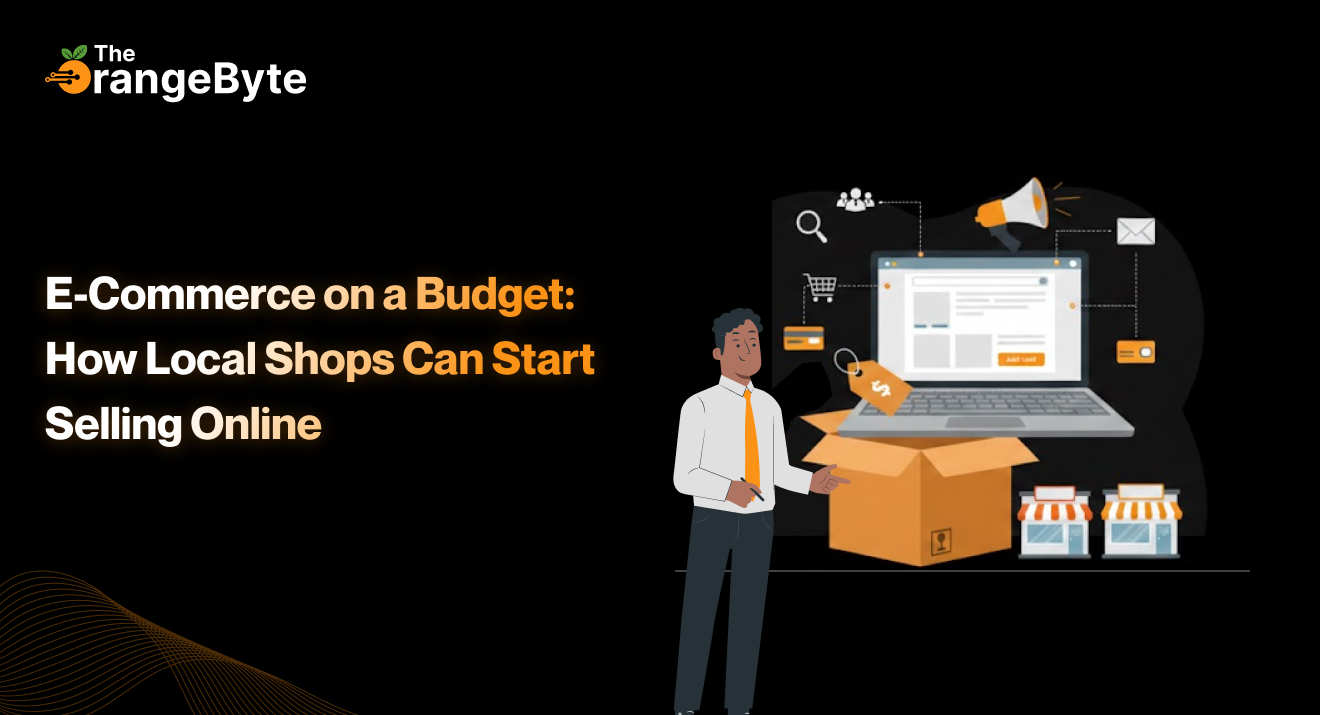
E-Commerce on a Budget: How Local Shops Can Start Selling Online
Last month I talked to Mark, who owns a bookstore in Greenville. He’s been doing this for 12 years. Real solid reputation. People know him. They love the store. But something changed last year.
His foot traffic dropped 30%.
He didn’t understand it at first. Then it hit him. His customers weren’t avoiding him—they were just ordering books on Amazon. Click. Done. Two days later, the book’s at their door.
Mark did what most local business owners do when this happens: He panicked. Seriously considered whether it was time to close up shop.
Then one night, he had a different thought. What if he didn’t fight the online thing? What if he just… joined it?
He spent a couple of hours setting up a Shopify store. Cost him $29 a month. Nothing fancy. Just his popular books, some photos he took on his phone, and simple descriptions.
Three months later? He was getting 8-10 online orders every single week.
Let’s do the math. That’s roughly $2,000-$3,000 in new revenue every month. Just from an online store.
And here’s the kicker: These weren’t customers replacing his in-store business. They were brand new customers. People from other towns. People who never would have stepped foot in his physical bookstore.
That’s the real opportunity here.
Why This Matters Right Now
Here’s what the numbers are showing us.
Physical retail footfall is down 35% since 2019. That’s a big shift. In the same period, online shopping has grown 220%. Those aren’t coincidences.
What does this actually mean for you?
58% of people are visiting physical stores less often. Almost 6 out of 10 customers. And 30%—nearly a third—are literally visiting stores just to look at things before buying them online.
Think about that. You could have a customer in your store, looking at a product, and they’re already mentally buying it from Amazon.
Your customers aren’t disappearing. They’re just shopping differently.
RETAIL FOOTFALL VS ONLINE GROWTH

Bar Chart showing:
- Retail footfall declined 35% (from 100 to 65)
- Retail revenue declined 28% (from 100 to 72)
- Online shopping grew 220% (from 100 to 220)
- 58% of consumers visit stores less often
The Retail Reality Check:
| Metric | 2019 Baseline | 2024 Status | Change |
| Retail Store Footfall | 100% | 65% | ↓ 35% |
| Retail Store Revenue | 100% | 72% | ↓ 28% |
| Online Shopping Growth | 100% | 220% | ↑ 120% |
| Consumers Visiting Less | N/A | 58% | Critical |
| “Check in store, buy online.” | N/A | 30% | Lost sales |
Source: Retail Impact Study 2024, Consumer Behavior Analysis
Now here’s the thing: You don’t have to choose physical OR online.
The smart retailers right now? They’re doing both. They call it “omnichannel.” Customer browses online? Great. Customer picks it up in-store? Perfect. Customer discovers you on Instagram and visits the shop? Even better.
It’s not either/or. It’s both/and.
The Real Opportunity
Let me put this in perspective because the numbers are actually kind of wild.
Global e-commerce hit $6.86 trillion in 2025. Trillion. With a T.
That’s projected to jump to nearly $8 trillion by 2027.
For context: that’s more money than the entire GDP of most countries. The scale of this market is genuinely massive.
One more stat that matters: 21% of every retail transaction now happens online. One out of every five. By 2027? That’s going to be closer to one out of four.
Are you not capturing that? You’re leaving serious money on the table.
GLOBAL ECOMMERCE MARKET GROWTH
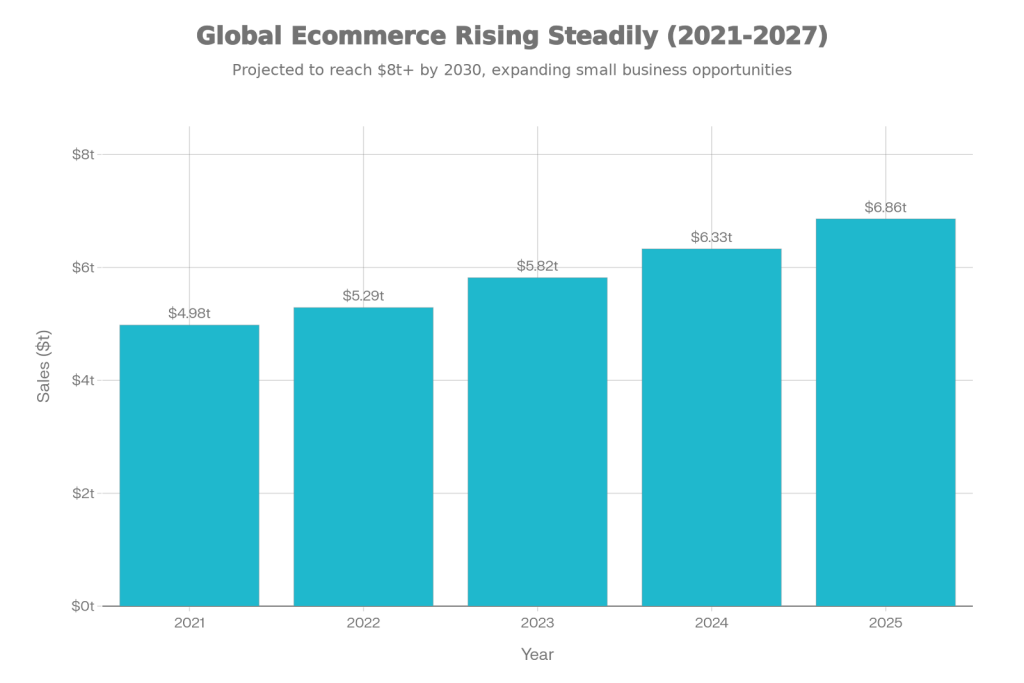
Bar Chart showing:
- 2021: $4.98 trillion
- 2022: $5.29 trillion
- 2023: $5.82 trillion
- 2024: $6.33 trillion
- 2025: $6.86 trillion (current)
- 2026: $7.41 trillion (projected)
- 2027: $7.96 trillion (projected)
Global E-Commerce Growth Trajectory:
| Year | Sales (Trillions) | Growth Rate |
| 2021 | $4.98T | Baseline |
| 2022 | $5.29T | +6.2% |
| 2023 | $5.82T | +10.0% |
| 2024 | $6.33T | +8.8% |
| 2025 | $6.86T | +8.4% |
| 2026 (P) | $7.41T | +8.0% |
| 2027 (P) | $7.96T | +7.4% |
Source: eMarketer, Statista E-Commerce Reports 2025
That’s growing about 8% a year. More than double what brick-and-mortar retail is growing.
Here’s the beautiful part, though: Most of this growth isn’t Amazon crushing everyone. It’s small businesses. Independent retailers. Local shops like yours.
The playing field isn’t tilted anymore. You can actually compete.
The Budget Myth
This is where most local shop owners get it completely wrong.
They think going online costs $50,000. Maybe they saw some fancy agency proposal once and never forgot it.
It doesn’t cost that. Not even close.
You can legitimately start an e-commerce business for $1,000 to $3,000. That’s real money, but it’s not devastating.
If you want a more complete setup with decent inventory and some actual marketing budget? $5,000-$10,000.
Compare that to what you’re losing by not being online.
ECOMMERCE STARTUP COSTS
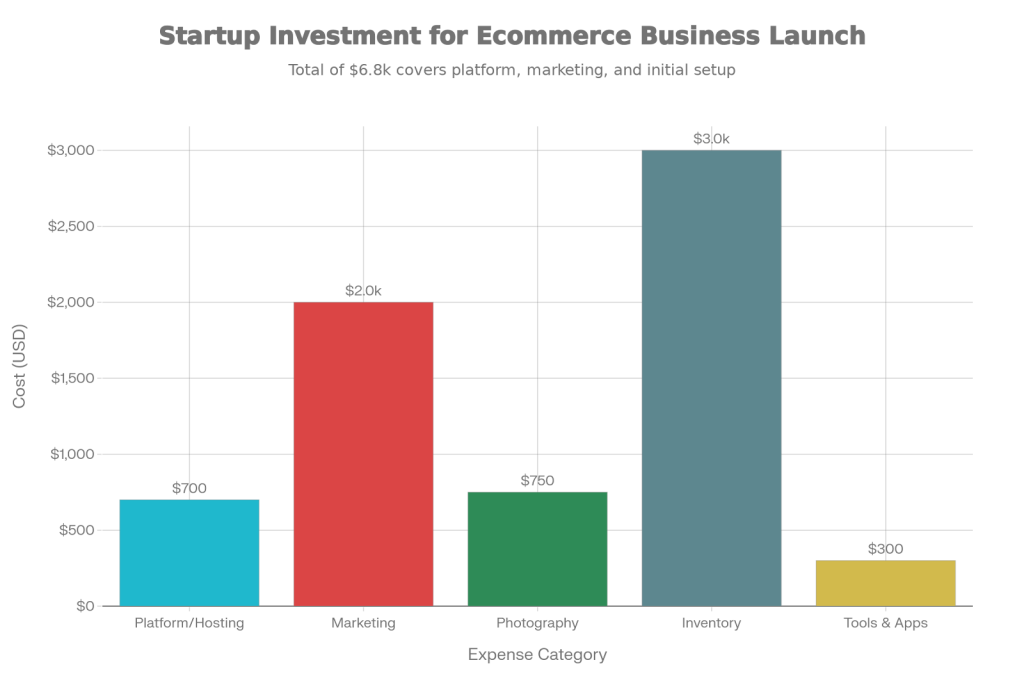
Bar Chart showing typical startup investment:
- Platform/Hosting: $700
- Marketing: $2,000
- Photography: $750
- Inventory: $3,000
- Tools & Apps: $300
- Total: ~$6,750
- (Or as lean as $1,000-$3,000 with dropshipping)
Real E-Commerce Startup Budget Breakdown:
| Category | Lean Budget | Full Launch |
| Platform (Shopify/Wix) | $9-29/month | $500-1,000/year |
| Domain & Hosting | $50/year | $200/year |
| Initial Inventory | $500-1,000 | $3,000-5,000 |
| Product Photography | $0 (DIY) | $500-1,000 |
| Initial Marketing | $500 | $2,000-3,000 |
| Tools & Apps | $0-100 | $200-500 |
| Total Year 1 | $1,000-3,000 | $6,500-10,700 |
Sources: Upmetrics Startup Cost Study, BDOW E-Commerce Research
Let me break down the platform costs because this is where people get confused.
You’ve got cheap options that actually work:
Shopify Lite starts at $9 a month. You can sell through social media or add a basic store.
Wix eCommerce is $17 monthly. Drag and drop. Even non-technical people can figure it out.
Big Cartel lets you list five products for free, then it’s under $10 a month to start.
WooCommerce runs you like $5-20 a month for hosting, depending on who you use.
Square Online is literally free. You just pay per transaction.
Then the mid-range stuff:
Shopify Basic is $29 a month. Most people I know recommend this. Full feature set without going crazy expensive.
Volusion is $22 a month.
Real talk: You can have a functioning online store for less than $300 in setup costs. Monthly recurring? $20-40, depending on which platform you pick.
That’s not expensive. That’s doable.
ECOMMERCE PLATFORM PRICING
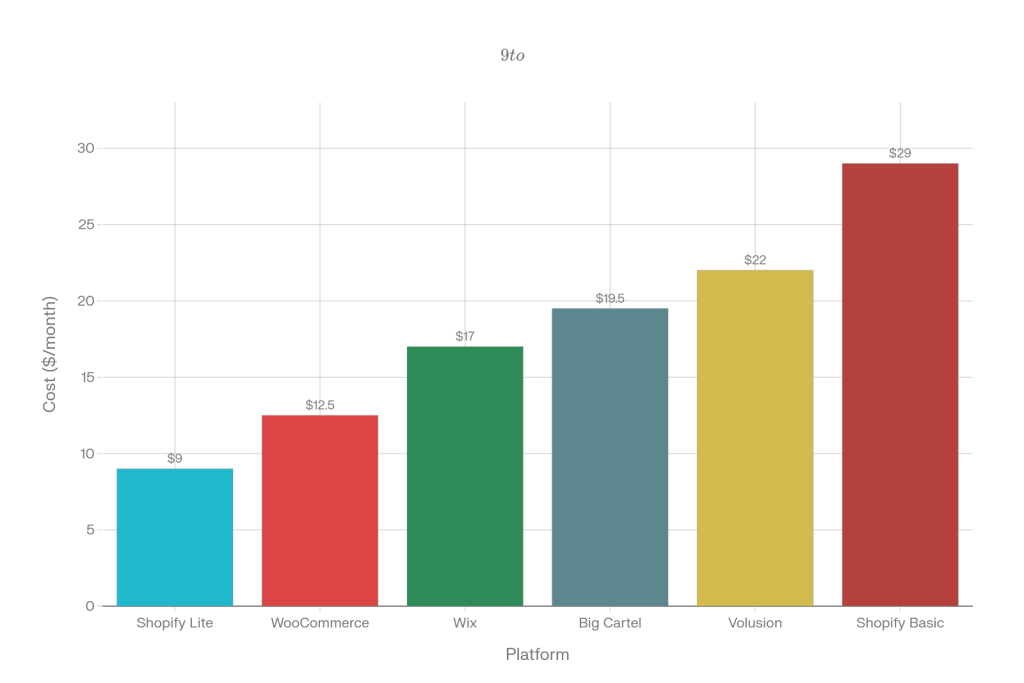
Bar Chart comparing monthly costs:
- Shopify Lite: $9/month
- Wix: $17/month
- Big Cartel: $19.50/month (average)
- WooCommerce: $12.50/month
- Volusion: $22/month
- Shopify Basic: $29/month
And here’s the thing: You won’t stay at the lean budget if you actually execute. Good problems to have, right?
Understanding Where Your Customers Come From
Before you launch anything, you need to understand one thing: 2.77 billion people shop online globally.
But not all website visitors are created equal.
Some people land on your site ready to buy. Others are just browsing. Some will never buy from you.
Different traffic sources convert at wildly different rates. This matters because it changes where you should focus your energy.
CONVERSION RATES BY TRAFFIC SOURCE
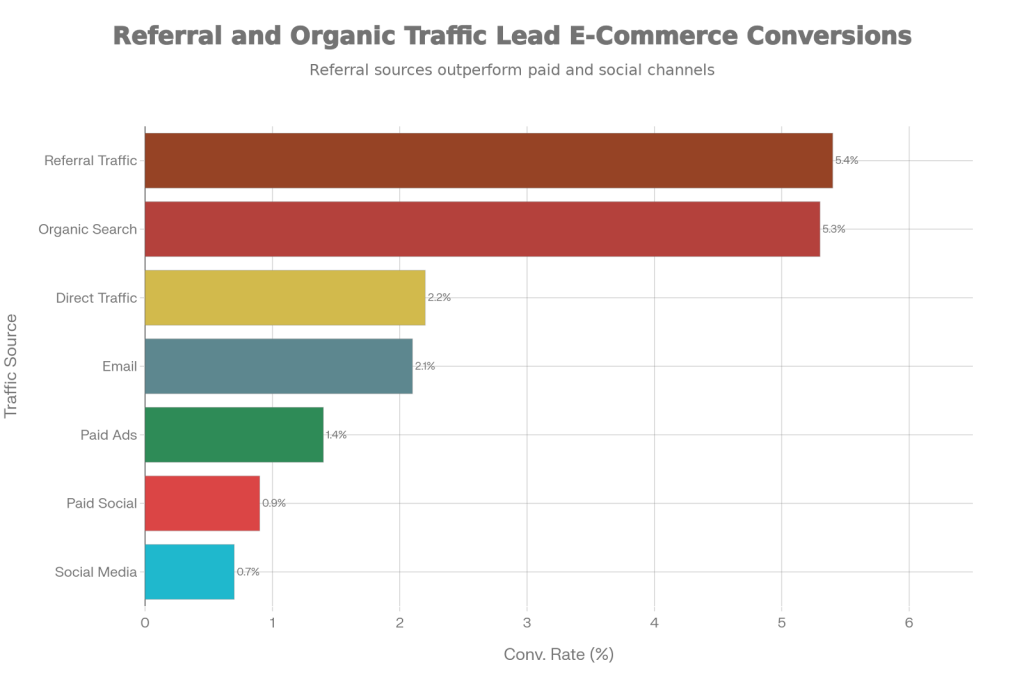
Horizontal Bar Chart showing conversion rates:
- Referral Traffic: 5.4% (BEST)
- Organic Search: 5.3% (EXCELLENT)
- Direct Traffic: 2.2%
- Email: 2.1%
- Paid Ads: 1.4%
- Paid Social: 0.9%
- Social Media: 0.7% (LOWEST)
E-Commerce Conversion Rates by Traffic Source:
| Traffic Source | Conversion Rate | Cost per Click | Best Use |
| Referral (word-of-mouth links) | 5.4% | Free | Long-term |
| Organic Search (Google) | 5.3% | Free | Evergreen |
| Direct Traffic | 2.2% | Free | Brand loyalty |
| 2.1% | Free | Existing customers | |
| Paid Google Ads | 1.4% | $1.50 | Short-term boost |
| Paid Social Ads | 0.9% | $0.75 | Brand awareness |
| Social Media Posts | 0.7% | Free | Community building |
Source: Red Stag Fulfillment, E-Commerce Conversion Study 2025
Here’s what actually matters: The traffic you have to PAY for converts worst. 1.4% from paid ads.
The traffic you get for FREE? That converts best. 5%+.
This changes everything about how you should spend your money early on.
Don’t blow your budget on ads initially. Instead:
Focus on organic search. Write about what your customers are actually searching for.
Get referrals working. Make it stupidly easy for customers to recommend you.
Build your email list. People who give you their email are way more likely to buy.
Paid ads? They have their place. But not at the beginning.
The Device Reality: Mobile Is Your Traffic, Desktop Is Your Revenue
Here’s something that trips up a lot of new e-commerce people.
Mobile devices send you most of your visitors. Like, 60% of people browsing your site are on phones.
But that’s not where most of your money comes from. It’s weird but true.
REVENUE DISTRIBUTION BY DEVICE
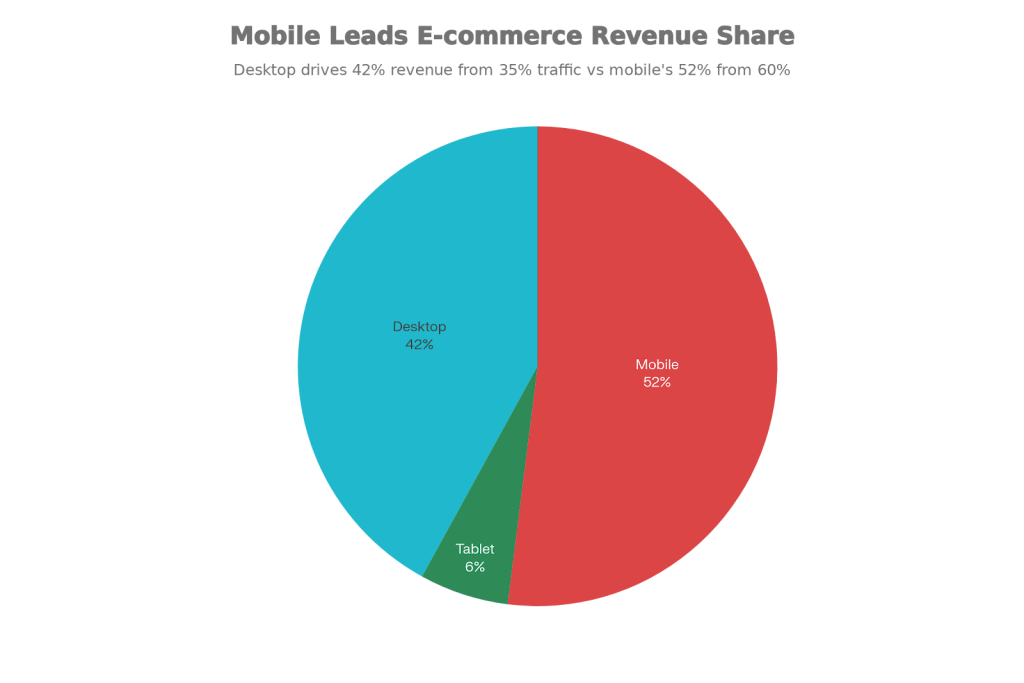
Pie Chart showing:
- Desktop: 42% of revenue (35% of traffic)
- Mobile: 52% of revenue (60% of traffic)
- Tablet: 6% of revenue (5% of traffic)
E-Commerce Traffic vs Revenue by Device:
| Device | Share of Traffic | Share of Revenue | Conversion Rate |
| Desktop | 35% | 42% | 2.8% |
| Mobile | 60% | 52% | 2.8% |
| Tablet | 5% | 6% | 3.1% |
Source: E-Commerce Benchmarks 2025, Shopify Data
So what does this tell you?
Mobile gets the most eyeballs. 60% of people browsing are on phones.
But desktop customers spend more. They add more to the cart. They actually finish the checkout process.
Tablet users? Surprisingly high conversion. They’ve got screen real estate, but still the mobile experience.
The practical takeaway: Your store MUST work great on mobile. But don’t neglect the desktop. Make sure checkout is smooth everywhere.
What Conversion Rate Should You Actually Expect
Nobody tells this to new e-commerce owners, and they get discouraged.
The average e-commerce conversion rate is 2.5-3%.
That means if 100 people visit your store, 2 or 3 will buy something.
New people see that and think they’re failing. “Only 3%?”
No. That’s normal. That’s solid.
Top performers hit 4%. Exceptional stores hit 5%+.
But here’s the catch: New stores often see 0.5-1.5% initially. That’s normal too.
The game isn’t hitting perfection on day one. The game is getting better over time.
How to Actually Get Started
If you’re thinking about doing this, here’s the real step-by-step:
Week 1-2: Research & Planning
Get on a free Shopify trial. Spend a couple of hours exploring. Look at five competitor websites in your space. What’s working for them? What’s weak? Write down your top 20-30 products—the ones that sell best or that you’re most excited about.
Week 3-4: Build
Pick a simple theme. Write product descriptions. Take photos. Use your phone. Natural lighting. Consistent background. Set up payment processing. Configure shipping.
Week 5: Soft Launch
Go live with just those 20-30 products. Email your existing customers: “Hey, we’re online now!” Post on social media. Test the whole checkout yourself—order a $1 item.
Week 6+: Optimize & Add
Watch which products sell online. Update descriptions based on what works. Add more products. Check Google Analytics. See what’s actually happening.
Month 2-3: Scale
Automate email follow-ups. Sync inventory if you have a physical store too. Plan the next batch of products. Start thinking about basic SEO.
Where Website Development Actually Helps
Here’s where most local shops run into problems: The technical stuff.
You can build a basic store yourself on Shopify. But you’ll hit limits.
What if your inventory system needs to sync with your in-store POS? What if you want custom features your competitors don’t have? What if your design doesn’t actually look like your brand?
This is where professional Website Development becomes valuable. Not to build from scratch. But to optimize what you’ve got and handle the complex technical pieces.
As you grow, Social Media Marketing becomes important too. Early on, that 0.7% conversion rate from social media seems terrible. But if you build a real following? Social becomes your biggest traffic source by volume.
Think about it: Organic search gets you 100 visitors. Social gets you 10,000 (even at 0.7% conversion). Social actually gives you more sales.
Successful e-commerce businesses eventually invest in both professional website optimization AND consistent social media strategy. They work together.
Mistakes Everyone Makes
Mistake 1: Expecting overnight success.
Your store won’t do $10,000 a month in month one. Real timeline looks like:
- Months 1-2: Setup and learning. Barely any sales.
- Months 3-4: 5-10 orders weekly
- Months 5-6: 10-20 orders weekly
- Months 7-12: Steady growth as Google starts ranking you
Mistake 2: Bad photos.
Your customers can’t touch the product. They’re buying based on images. Invest time here:
- Shoot near a window (natural light)
- Take photos from multiple angles
- Keep backgrounds consistent
- Keep the style uniform
Terrible photos lose sales. Good photos increase conversions.
Mistake 3: Lazy product descriptions.
Your description should actually answer:
- What is this specifically?
- Who should buy it?
- What’s it made from?
- How big is it? (Dimensions matter)
- Why is it better than alternatives?
Vague descriptions lose sales. Detailed ones boost conversions.
Mistake 4: Ignoring email.
Email has a 2.1% conversion rate. It’s also FREE traffic you own. Collect emails from:
- Website signups
- Existing customers (with permission)
- Social followers
Email is your most profitable channel long term. Build that list.
Mistake 5: Launching with too much inventory.
Don’t launch with 500 products. Start with 20-30 of your best sellers. Get that experience nailed. Then expand.
More products = more complexity = worse customer experience.
Real Example: Clothing Boutique
Let’s say you run a women’s clothing boutique in a shopping center.
Before Going Online:
- 40 customers a week in the store
- Average purchase: $65
- Monthly revenue: $10,400
- Foot traffic declining 5% per year (that trend is real)
After Adding Online (3 months later):
- Still getting 40 customers a week in-store
- NOW PLUS 15-20 online orders weekly
- Average online order: $58
- Online revenue: $3,160-$4,240 monthly
- Total monthly revenue: $13,560-$14,640
Financial reality:
- Added revenue: $3,160-$4,240 monthly
- Platform cost: $30 (Shopify)
- Payment processing: ~$150 (2.2% of sales)
- Packaging/shipping: ~$400
- Marketing: $200 (start lean)
- Net gain: $2,000-$3,500 monthly
Over a year: $24,000-$42,000 in additional profit. From a store that cost $1,500 to launch.
And it scales. As photos improve and descriptions get refined, conversions go up. As Google ranks you better, traffic increases. By year two, you could be looking at double these numbers.
The Bottom Line
You don’t have to choose a physical store OR online.
Have both. Because in 2025, you actually need both.
The retail world has fundamentally shifted. 58% of people are shopping less in physical stores. That’s not about your store quality. That’s just how people shop now.
Your existing customers might shift online. New customers will definitely start online.
You can build a complete, professional, profitable online store for under $3,000.
ROI? Within 3-6 months, realistically $2,000-$5,000 monthly in additional revenue.
The question isn’t really “should I go online?”
It’s “how much longer can I afford NOT to be online?”
Quick Action Plan
This Week:
- Check out Shopify’s free trial (seriously, no credit card)
- Look at five competitor websites
- Write down what works and what doesn’t
This Month:
- Choose your platform
- Photograph your best 20-30 products
- Write descriptions
- Soft launch
This Quarter:
- Get your first 10-20 online orders
- See which products actually sell online
- Plan expansion to the next batch
- Watch your analytics
Source URLs:
https://www.shopify.com/in/blog/small-business-statistics
https://unctad.org/publication/business-e-commerce-sales-and-role-online-platforms
https://www.statista.com/topics/871/online-shopping
https://www.designrush.com/agency/ecommerce/trends/ecommerce-statistics