
A software idea can look simple on paper. Then the feature list starts growing.
A customer portal becomes an app. The app needs payments, notifications, dashboards, integrations, automation, user accounts, and a dozen other features. Before long, a business is preparing to spend months and a significant budget building something it hasn’t fully validated.
That’s where a minimum viable product, or MVP, can help.
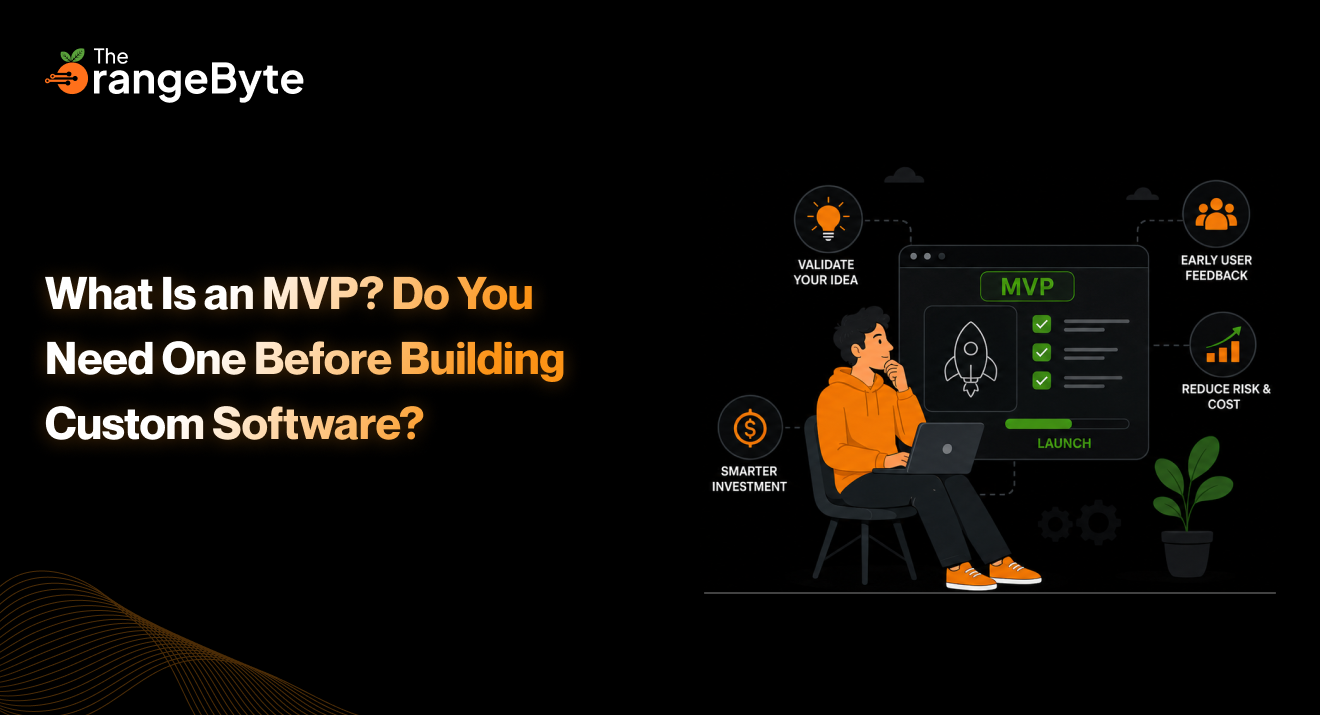
An MVP is a usable version of a software product built around its most important functionality. It gives businesses a way to test an idea, gather feedback, and learn what users actually need before investing in a larger product.
But there’s an important question that often gets overlooked:
Does every business need an MVP before building custom software?
No.
For an untested product idea, developing an MVP can reduce uncertainty. But when a business already understands its customers, requirements, and workflows, moving directly into Custom Software Development may be the better choice.
The goal isn’t to build an MVP simply because it’s popular. It’s to choose the development approach that makes the most sense for the business.
An MVP Is More Than a Smaller Version of Your Final Product
A minimum viable product is a working version of a software product that provides enough value to its intended users while allowing the business to learn from real-world use.
The word “minimum” doesn’t mean low quality.
It means focusing on the smallest set of functionality needed to solve the primary problem and test important assumptions.
Imagine a company wants to build an appointment-booking platform for service businesses.
The eventual product might include:
- Online payments
- Automated reminders
- Staff scheduling
- Customer accounts
- Calendar integrations
- Reporting
- Mobile apps
- Marketing automation
An MVP might start with just:
- Service selection
- Appointment scheduling
- Customer information
- Confirmation
That Software MVP can answer an important question:
Do customers actually find this solution useful?
If they do, the product can grow based on what the business learns. If they don’t, the company can change direction before investing heavily in every feature on the original roadmap.
MVP, Prototype, or Proof of Concept?
These terms are often confused.
A prototype is usually created to explore an idea or demonstrate how an experience could work. It might be a clickable interface or visual representation without a complete working backend.
A proof of concept (POC) focuses more on technical feasibility. It might answer a question such as:
“Can this new application connect with our existing system?”
An MVP goes further. It is designed to provide actual value to users while generating useful feedback about the product.
Understanding the distinction matters because a business doesn’t necessarily need to build a complete MVP to answer a technical question. Sometimes a POC is enough. In other situations, a prototype can validate the user experience before development begins.
The Biggest Benefit of an MVP Is What It Teaches You
The strongest argument for MVP development isn’t simply that it can produce a smaller first release.
It’s that it allows businesses to test assumptions.
Before development, teams often assume:
- Customers will use the product.
- Certain features will be essential.
- Users will understand the workflow.
- Customers will pay for the solution.
- The proposed process will solve a real problem.
Some assumptions will be right. Others won’t.
An MVP allows the business to put a working solution in front of real users and learn from their behavior.
That feedback can help answer:
- Which features actually matter?
- Where do users get stuck?
- What are they asking for?
- Which parts of the product do they ignore?
- Does the product solve the original problem?
- Is the idea worth developing further?
Those answers can be more valuable than months of internal discussions about what customers might want.
Should You Build an MVP or Go Straight to Custom Software?
There isn’t one answer for every project.
| Situation | Potentially Better Approach |
| New idea with uncertain demand | MVP Development |
| New business model | MVP Development |
| Unclear customer requirements | MVP Development |
| Proven business need | Custom Software Development |
| Established internal workflow | Custom Software Development |
| Clear technical requirements | Custom Software Development |
| Proven product that needs expansion | Custom Software Development |
| Complex security or compliance requirements | Full production development may be better |
This isn’t a rigid rule.
A new product may require substantial technical work from the beginning. Likewise, an established company may still benefit from an MVP when testing a completely new service or customer experience.
The deciding factor should be uncertainty.
If you have something important to learn, an MVP may be valuable.
If the problem and solution are already well understood, a full build may make more sense.
For businesses weighing custom development against existing software, [Read: Custom Software vs Off-the-Shelf: What Greenville Businesses Really Need] provides useful context.
When an MVP Makes the Most Sense
An MVP is particularly useful when a business is entering uncertain territory.
You’re Testing Whether Customers Want the Product
If the idea hasn’t been proven, an MVP gives potential customers something real to evaluate.
You’re Entering a New Market
Even an experienced company may not fully understand how a new audience will use a product.
Your Feature List Keeps Growing
An MVP forces the team to identify the core problem rather than trying to build everything at once.
You’re Testing a New Business Model
If you’re uncertain whether customers will pay for the proposed solution, early validation can prevent a much larger investment in the wrong direction.
You Need Real User Feedback
Internal opinions are useful, but they aren’t a substitute for seeing how customers actually use the product.
When Skipping an MVP May Be Smarter
An MVP isn’t automatically the right choice.
Consider a business replacing spreadsheets and manual processes with a centralized internal system. If employees have used the same workflow for years and the requirements are already documented, there may be little value in creating a temporary MVP.
Direct Custom Software Development may be more efficient.
Skipping an MVP can also make sense when a project involves:
- Strict security requirements
- Regulatory requirements
- Complex integrations
- Critical business infrastructure
- Clearly defined users and workflows
- A proven product that already has market demand
In these situations, the business may need a production-ready solution from the start.
For more information about planning a custom development project, [Read: Custom Software Development in Greenville SC: What to Expect].
What Should Actually Go Into an MVP?
Once you decide to build one, resist the temptation to include everything.
Start with the primary user problem.
Then ask:
- What does the user absolutely need to accomplish?
- Which features make that possible?
- Which features are necessary to test our biggest assumptions?
- What can wait until we have feedback?
For a home-service scheduling app, the core journey might be:
Choose service → Select time → Enter information → Confirm appointment
That’s the foundation.
A loyalty program, advanced analytics, referral system, or AI recommendation engine might be useful later, but they don’t necessarily need to be part of the first release.
The MVP should be focused, usable, and capable of generating meaningful feedback.
From Idea to MVP: A Practical Development Path
A good MVP doesn’t start with coding.
1. Define the Problem
Be specific about the problem you’re solving.
2. Identify the User
Know who will use the product and what they need to accomplish.
3. Map the Core Workflow
Define the simplest path from the user’s problem to the desired outcome.
4. Prioritize Features
Separate must-have functionality from features that can wait.
5. Design the Experience
Make sure the product is understandable and usable before development gets too far along.
6. Build and Test
Develop the core functionality, test it thoroughly, and put it in front of real users.
7. Learn and Decide
Use feedback and usage data to determine whether to improve, expand, change direction, or stop.
That last step is important. An MVP isn’t successful simply because it launches.
It’s successful when it produces useful information for the next business decision.
What Happens After the MVP?
An MVP is a starting point, not necessarily the final product.
Once users begin interacting with it, the business may discover that:
- A supposedly important feature isn’t being used.
- Users need a different workflow.
- A missing feature is more valuable than expected.
- The product needs stronger integrations.
- Performance needs to improve as usage grows.
- Customers are ready for additional functionality.
That’s when a business may move toward broader Custom Software Solutions.
The next stage could involve improved architecture, additional features, integrations, security enhancements, automation, or infrastructure designed for a larger user base.
The MVP provides the evidence. The next development stage turns that evidence into a more complete product.
For startups considering alternatives to traditional development, [Read: App Development vs No-Code: Why Greenville Startups Get This Wrong] can also help explain the trade-offs involved.
Don’t Confuse Fast Development With Careless Development
One common MVP mistake is treating speed as the only goal.
A rushed product can create bad feedback.
If users abandon an MVP because it’s confusing, unreliable, or difficult to use, the business might incorrectly conclude that customers don’t want the product.
The problem may actually be poor execution.
Even an MVP needs appropriate attention to:
- Usability
- Security
- Data handling
- Testing
- Performance
- Maintainability
- Technical requirements
The objective is to reduce unnecessary scope—not to remove everything that makes the product usable.
The Right Question Isn’t “Do We Need an MVP?”
The better question is:
“What do we still need to learn?”
If you’re uncertain whether customers want the product, an MVP can help.
If you’re unsure which features matter, an MVP can help.
If you’re testing whether a particular technology is possible, a proof of concept might be more appropriate.
But if your business already understands the problem, customers, workflow, and requirements, moving directly into Custom Software Development may be the smarter route.
The best development strategy isn’t necessarily the one that starts with the smallest product. It’s the one that gives the business the right information and technology at the right time.
Build With Evidence, Not Assumptions
An MVP can be a smart way to test an uncertain software idea before making a larger investment. But it isn’t a mandatory step for every business.
If there’s significant uncertainty around customer demand, product features, or the business model, MVP Development can provide valuable evidence.
If the business already understands the problem and has clear requirements, moving directly toward Custom Software Solutions may be the better path.
The important thing is to make that decision before development begins.
The OrangeByte helps businesses evaluate software ideas, define practical requirements, and determine whether an MVP or a larger custom build makes sense for their goals.
Ready to turn your software idea into a practical plan?
Whether you need an MVP to validate your concept or a complete custom solution, start the conversation online and let’s determine what makes sense for your business.
Frequently Asked Questions
Is an MVP required before custom software development?
No. An MVP is most useful when a business needs to validate assumptions or gather early user feedback. A project with clear requirements may be better suited to direct custom development.
Can an MVP become the final product?
Yes. Some MVPs can evolve into the larger production product. Others may be significantly redesigned after user feedback reveals what needs to change.
How do you decide what features belong in an MVP?
Start with the primary customer problem. Include the functionality required to solve that problem and test your most important assumptions. Everything else can be evaluated later.
Is an MVP always cheaper than full software development?
Start with the fundamentals: accurate business information, useful website content, strong local SEO, genuine reviews, clear service pages, and credible references from relevant sources.
Is GEO replacing SEO?
No. GEO should be viewed as an additional consideration within a broader search and digital marketing strategy rather than a replacement for SEO.